Showing posts with label Podhale. Show all posts

Wednesday, June 17, 2015

Zakopane sightseeing: Gubalowka – the best view of Tatras

Gubalowka - one of the most interesting view points of the Tatras, easily accessible and therefore, unfortunately, often very crowded. Many tourists ascend the peak using the funicular and go for souvenir shopping or to find restaurant to satisfy hunger. However, I would to write about different Gubalowka - interesting objects in the vicinity of the summit and what you can see from the top because the panorama is one of the best views of the Tatras.


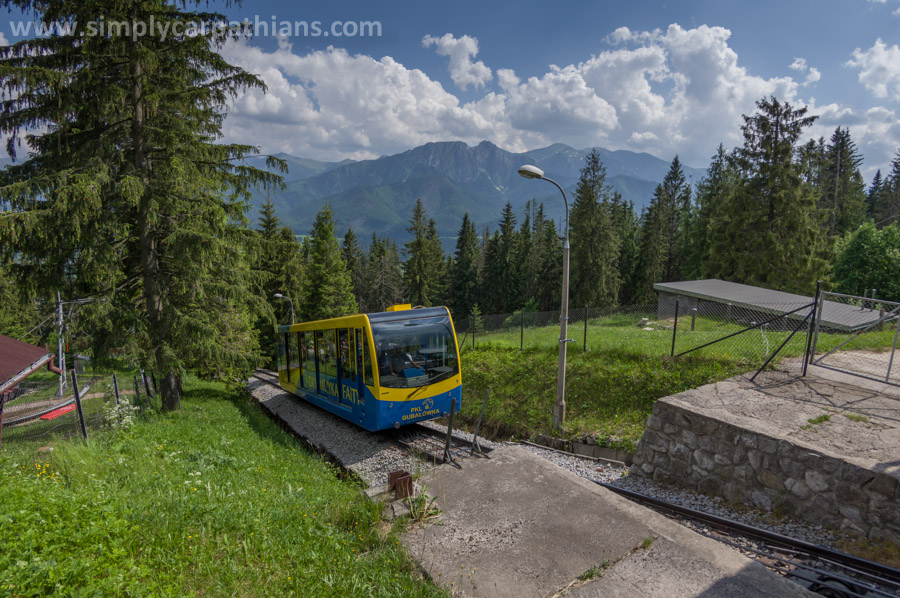
The Gubalowka mountain ridge is full of housing buildings - this is the highest settlement (1122 m a. s. l.) in Poland and it belongs administratively to Zakopane. The largest oject visible from afar is the Radio and TV Tower, nowadays also providing mobile phone coverage and satellite television. The funicular is the most often visited attraction. It was built in 1938 and modernized fifteen years ago. The summit can also be reached by numerous hiking trails leading to Gubalowka from different directions.
You have to go down a few dozen meters from the upper funicular station to see the full panorama of the Tatras. The view covers most of the Tatra Mountains - from the Belianske Tatras to the distant peaks of the Western Tatras. The most conspicuous is Giewont Mountain with its silhouette of sleeping knight. You can also recognize almost every building in Zakopane, the complex of ski jumps and many other objects. Unfortunately it is impossible to see Rysy (the highest mountain of Poland) and Gerlach (the highest peak in the Tatras) from Gubalowka.

One of the worth seeing objects is the monument called Polonia Restituta located near the upper station of the funicular. Two-meter bronze figure shows the resurgent Poland. On the left hand of the woman there is sitting an eagle with spread wings ready to fly. The sculpture was made by Stanislaw Kaniak for world exhibition Art and technology in contemporary life in Paris in 1937.

Another interesting object is a metal cross standing near the Radio and TV Tower. It was commissioned in 1873 by Titus Chałubiński in Kuznice (local ironworks). The cross was founder's public confession of faith and it also commemorates his reconciliation with the family.

Gubalowka is worth visiting at any time of the year because of the spectacular views. I recommend to explore the area in the morning hours to do it in peace and quiet.

Saturday, May 30, 2015

Macrophotography: round-leaved sundew

Photographing the round-leaved sundew is not a quite easy thing. But don't be afraid, you do not have to be a professional with years of experience and very expensive equipment for macrophotography. The difficulties lie in the fact the majority of people simply do not notice it ;)


So firstly, you need to locate the sundew – its tiny leaves are almost whole green and it is hard to spot them among the bogs. I have spent more than an hour during a photographic tour on the wetlands before I found the first specimen and took a photograph of it. I must add that it wasn't my first search.

As for the shooting, should you choose the morning time when the light is not too sharp and there are still morning dew drops on the hairy leaves. Under a cloudy sky, you can make use of an artificial light source - a flash or headlamp. A plain white sheet of paper reflecting daylight may also be useful. Of course, interesting pictures can also be taken in the rain - the best is drizzle with tiny water droplets which gather on the leaves. Almost each leaf contains undigested remains of insects - sundew is real carnivorous plant!

You can tak macro photos by almost any type of camera - from small compact devices with often very good macro mode to SLR cameras with special lenses for macrophotography. Most of the following images were taken with SLR Pentax K-3 with the Soviet lens Helios 58mm type M42 attached to the camera with the appropriate adapters and rings for macrophotography.

Where to find the sundew? It can be often found in bogsmarshes and fens. The pictures where taken on the peat bog near Nowy Targ (Lesser Poland). Sundews grow there next to the observation platform, half a meter from the railings.


If you want to learn more about macrophotography and see those amazing plants – you are warmly welcome to our photo-tours and workshops.


Friday, May 22, 2015

Nature reserve - Bór na Czerwonem


Recently we have been discovering the charms of picturesque place which is the Nature Reserve Bór na Czerwonem. It is located in Podhale, Lesser Poland. The place has the true recreational potential - Nordic walking and cross country trails are led here, it can also be the target of a bicycle tour or a stroll. Some come here at odd hours and roam around with a camera ;) However, the nature reserve is primarily the place where extremely interesting species of plants are protected.

The area has been protected since 1925 but it was given the status of a nature reserve in 1956. Bór na Czerwonem is peatbog reserve, in which the raised bogs ecosystem (supplied with rainwater) and surrounding it humid forest communities are protected. This is an example of peatlands typical for Orava-Nowy Targ region. 


The name (czerwone = red) the reserve owes to algae, which in autumn assume a red color. But we can see here many more interesting species typical for the wetlands such as sphagnum moss, Cranberry, cotton-grass, different types of pine or fascinating common sundew. If these names do not say anything to you - just come here and see for yourself what a beautiful landscape they form :)


Friday, February 13, 2015

Kumoterki - traditional sleigh race

Kumoterki - traditional sleigh race
Kumoterki is the name of the sport discipline popular in Podhale region in Poland. The team (a couple and a horse) tries to get the highest score in a sleigh race. Usually a man is teaming and a woman acts as a ballast ;) But sometimes the roles are switched. The oval-shaped track is approx. 400 meters long and the audience is standing around it. 

Another contest is skiring where skiers teaming horses compete. In the second version called ski-skiring one person is riding a horse and a second one - the skier is only trailed. Everything is very spectacular and exciting. 

The competition is preluded by Parada Gazdowska (can be translated as Farmers Parade). It is also some kinde of contest but a bit more static ;) Farmers dressed in the regional costumes ride in the decorated sleigh pulled by bedecked horses. During the parade they are scored by the jury. The referees mark horses, harnesses, sleigh and the owners. It is a great chance to see the traditional highlanders outfit and hear the regional music.

When and where can we watch the contests?

The competitions are held in Podhale region during the carnival. You can watch them every sunday in a different village: Kościelisko, Poronin, Biały Dunajec, Bukowina Tatrzańska, Ludźmierz and others. The best idea is to ask in the visitors centers in Podhale - they will inform you about the dates of the contests. Some information you can also find on the official website: www.kumoterki.pl (only in Polish). 


Monday, March 24, 2014

Shepherding in the Tatra and other Polish mountains

Autumn morning, I'm sitting in the kitchen and sipping coffee. Suddenly I hear gentle buzzing, with time the sound becomes clearer. I look out the window and see a flock of sheep moving along the road towards the nearby meadows. Small bells tinkle hung on the neck of some sheeps. Ah, the owner is leading his herd to the pasture. Grazing season, which traditionally runs from April 23 (St. Wojciech day) to September 29 (St. Michael the Archangel day) is already completed - the sheep descended from the Tatra mountain pastures. Now they are driven only on the foothill meadows.
 
Pastoral customs, traditions, techniques and equipment came to the Polish mountains from the south. They were strongly influenced by Vlachs - nomadic people coming from the Balkan area, who in the early Middle Ages began centuries long pilgrimage to the north. Nomads assimilated with the inhabitants of the Carpathian range and taught them new skills. Pastoral way of life came upon a breeding ground - difficult natural conditions (harsh climate and poor soil) favoured more animal husbandry than cereal farming. Shepherding started to develop in the Tatra and other Polish mountains
 
What did the traditional pastoral season look like? Each owner wanted to send his sheep to the mountain pasture for summer. It would entail leaving the household for several months, what was impossible. Therefore the function of baca (the main shepherd) was established a man to whom farmers entrusted their flocks for summer time grazing. Baca was choosing some helpers – younger shepherds and set off to the mountain pastures owned by the village. Walking to the pastures called redyk could last even several days, depending on how far from the mountains the village was located. On a pasturage shepherds lived in a wooden hut called bacówka. Apart from grazing they were protecting sheep from predators or getting lost and manufacturing products ​​from sheep's milk. The best known are three types of cheese - oscypek, bundz and bryndza. Grazing was terminated with autumn redyk - sheep descent from the mountains. It was a very solemn event, accompanied by singing and music. Then the main shepherd settled up with sheep owners and returned them their flocks. Children welcoming redyk were receiving little pieces of cheese in the shapes of animals. Many traditions and superstitions associated with the pastoral season come from a borderline between religion and pagan beliefs. They are subject of a number of ethnographic research nowadays.

What about shepherding in the Polish mountains today? History of individual pastoral areas and its influence on contemporary sheep grazing caused diversification of shepherding in different regions of Poland. Idyllic view with sheep in the mountain pastures is not as common as it was in the past. Nevertheless we can still meet shepherds or even visit their huts while hiking on the mountain trails in Gorce, Beskids or Pieniny. In some areas (eg in the Bieszczady Mountains) the aim is to renew the tradition of pastoralism.

In the Tatra Mountains, where shepherding had been completely liquidated due to the nature conservation in the 70's, it was decided to restore grazing. Decisive influence had cultural issues - perennial relationship between the highlanders and the Tatras and richness of traditions and customs as its effect. In 1981, shepherding returned in a form of so-called Cultural grazing of sheep and cattle in the Tatra Mountains. What does it mean? Under agreements with the Tatra National Park highlanders can graze sheep on some of the clearings. They must, however, obey several rules including speaking in a dialect, wearing the original highlander outfit, whether be assisted by traditional herding dogs – the Polish Tatra sheepdogs. The are many more requirements, but thanks to them we can learn more about old customs and try products prepared according to original recipes.

Extremely interesting event is the Carpathian Sheep Transhumance organized for the first time in 2013. It is an international project aimed at meeting people involved in shepherding across the whole Carpathian range linked together with an exchange of experiences. This is the traditional wander of shepherds and flocks through the mountain area of the Carpathian countries - Romania, Ukraine, Poland, Slovakia and Czech Republic. The trail is about 1,200 kilometers long (10-15 kilometers a day) and takes place between May and September. The wander is accompanied by various events.

Dusk, the day is slowly coming to the end. I hear the tinkling sound again ... The sheep are coming back to the pen for the night

TEXT WAS PUBLISHED ON LINK TO POLAND WEBSITE.


Thursday, February 13, 2014

Nordic walking - a way to discover new places


I would like to share with you my way of discovering new places. It matches exploration with a healthy lifestyle and gives lot's of satisfaction. It is Nordic walking.

After work...
...I just take my walking poles, do a quick warm up and go exploring fields and forests in the neighbouring area. Podhale (the Tatra Mountains foothills) is a beautiful region - there are many options for a walk, most of them with a beautiful view of the Tatras. Sometimes my husband takes me for a walk and shows me new trails, then I take there other people. An hour every day - it is enough to keep fit.
                                                       
                                                         Few hours - enough to explore the unknown
But there are also many intersting spots to see a bit further - distant parts of the Podhale region, Orava and Spis. All of them no more than half an hour by car from Zakopane. I look at the map, think up a destination, look for some fellows and go. We use field roads, hiking or cycling trails.


Mountain tours
Finally it is our way of visiting mountain ranges for the first time. Very often those are not very high mountains in Poland and Slovakia. Why not traditional hiking? Nordic walking is a kind of variety and facility. It brings also more benefits for health.

We take Nordic walking poles whenever we visit another part of the Carpathians. Nordic walking poles and proper technique - those are the only things you have to take with you. That is why it is so convinient ;)

Some people use Nordic walking for sightseeing. For example it is a good way of visiting Zakopane.

Think about it :) You can start Nordic walking in any time of the year, at any part of your life.

Monika
Nordic Walking Instructor