Thursday, May 30, 2013

Cycling trip around the Tatra Mountains

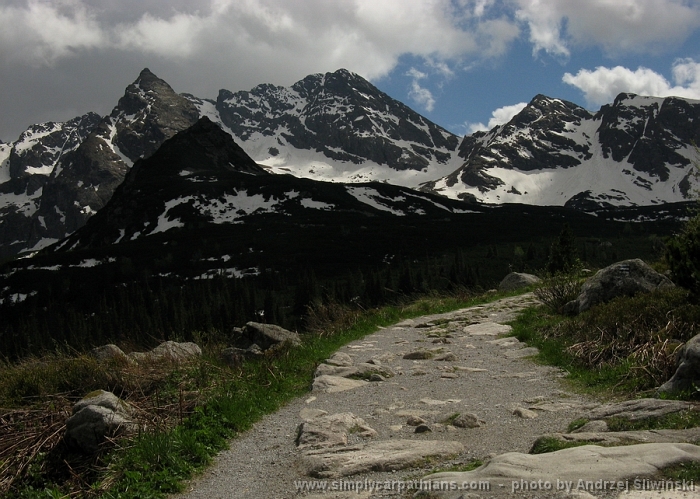
Going around the Tatras on a bike is a proposition for those who already have some experience in cycling and are convinced about their own physical abilities. Why? Because the distance of this trip is more than 200 km long and the height difference is around 2300 meters. The most popular option is to make this trip in 2 days but some cyclists do this during one day (8-11 h). If you want to visit some historical spots on your way, better divide the route into 3-5 days. There are several interesting places on the way like Zakopane, Chocholow, Jurgow and Bukowina Tatrzanska in Poland and Zuberec, Liptowski Mikulas, Prybylina in Slovakia. Of course you can go further and make some longer breaks for hiking trips in the Tatras. It is all up to you ;)


Summarizing: cycling trip around the Tatra Mountains is perfect both for weekend and longer vacations. It depends on your purpouse - just cycling or cycling combined with sightseeing and even hiking.

Where to sleep?
1st option: tent. There are several campings on the way. It is better to check whether the chosen camping is working because some are open only in summer season.
2nd option: private lodgings. There are plenty of them around the Tatras, a bit more on Polish side. Sometimes it may be difficult to find accomodation only for one night - in order to avoid problems I suggest to make a booking earlier.
3rd option: shelter in the mountains. Some shelters in the Tatra Mountains are accesible by bike. In Poland shelters in: Chocholowska (asphalt road), Bystrej and Sucha Woda valleys. In Slovakia shelters in Zarska (asphalt road) and Kiezmarska valleys.
4th option: hotels.
5th option: Couch Surfing ;)

Were to eat?
Generally there is no problem to find good place for lunch. Most of the towns and villages on our way are touristic and provided with bars and restaurants.

Uphills and downhills 
On the way there are several uphills and downhills that may be exhausting:
- mountain passes on the eastern and western edge of the Tatras,
- uphill to Štrbské Pleso (it is not necessary to enter the town, you can just pass through the crossroad),
- uphill to Bukowina Tatrzańska from Jurgow or Poronin. 

 
Types of roads
 You generally use main and side roads with asphalt surface. In Slovakia many of those roads are empty with a small trafic. In Poland there are a little bit more cars, but still it is not annoying. Of course there is less traffic on weekends.

If you search for some diversity and have more time you can choose a dirt road - the marked trail in the foothills of Slovak Tatra Mountains (on the south). It is not recommended after rain or in early spring when the snow is melting - it may be full of mud. 


ENJOY! :)

Friday, May 17, 2013

One-day hiking trips in the Polish Tatras


The Tatra Mountains are perfect for one-day hikes. You will find there simple routes suitable for short walks with children as well as medium and very difficult trails requiring abilities and experience. You just need to choose a route – it is good to check the maps and guidebooks or go for a trip with an experienced mountain guide. Some summits in the Polish Tatras are not available for tourists, some can be reached only by climbers. What is more – the school groups are obliged to hike only with a licensed mountain guide. When you hike in the Tatra National Park you also need to follow the marked trails – some rules are described on the Park’s website (site under construction).


 EASY TRAILS

Example: The valley floor of Dolina Koscieliska.
Very beautiful trail leads along the valley floor of the Koscieliska Valley. It is marked in green colour. The route starts in Kiry – a part of village Koscielisko. You can get there for example taking a mini-bus from Zakopane (in front of the bus station) or by car (car park in front of the entrance to the valley). It takes 1,5-2 hours to get to the mountain hut on the Ornak clearing by the simplest way but you can also visit some side trails (to Mrozna Cave or Krakow Gorge on the way back). Part of a trail you can make taking a buckboard – it may be a great fun for children. After a rest in the mountain hut there is also possibility to make a short walk to lake Smreczynski Staw or make some more difficult trips to higher parts of the Western Tatras. For those who feel that “it’s enough for today” – go back the same way to Kiry.

Other examples of simple trips:
The valley floor of Dolina Chocholowska, Dolina Bialego, Dolina Strazyska, Sciezka pod Reglami, Dolina Bystrej – to the mountain hut on a Kondratowa clearing, Kasprowy Wierch by a cable car, Morskie Oko
Dolina Chocholowska
MEDIUM HARD TRAILS

Example: Kuznice – Hala Gasienicowa - Kuznice
You can reach Kuznice (district of Zakopane) by a mini-bus (e.g. from the bus station), by a taxi or on foot – entering the district by your own car is forbidden. Kuznice is nowadays a headquarter of the Tatra National Park. In the past it was the main mining center in the Polish Tatras – you can visit there historical buildings, some are turned into museums. From Kuznice you take a blue trail (the one which leads in eastern direction). The trail will take you to the Hala Gasienicowa and a mountain hut “Murowaniec” via so-called Boczan. Climbing the brow of Boczan is the only difficulty on your way. After that you follow the rolling terrain admiring the beautiful views around you. The way back may be a little bit diversified by taking a yellow trail through Jaworzynka Valley and pass the old sheprds’ huts. 

Other examples of medium hard trails:
Cyrhla – Wielki Kopieniec – Dolina Olczyska – Nosal, Zazadnia – Wiktorówki – Gesia Szyja, Sarnia Skala.
On a way to Hala Gasienicowa
DIFFICULT TRAILS

The trails described below are mostly difficult because they require good physical condition.

Example: Czerwone Wierchy
Beautiful trip, especially in the late summer/early autumn when the plants covering that part of the mountains are getting red. Thanks to that plants we have the name of the mountains: “Czerwone Wierchy” simply means “Red mountains”. You start your trip in Kiry (mentioned above) but after around 20 minutes you turn left and change the trail from green to red one. That is a beginning of a real hiking ;) After 4 hours and 1000 meters of height difference you will reach the first summit of Czerwone Wierchy called Ciemniak. Then you follow the main Tatra Mountains ridge to the east through Krzesanica and Malolaczniak. On Malolaczniak you can decide to go down (taking the blue trail with one artificial facility placed on a short distance – a metal chain working as balustrade) or reach another summit – Kondracka Kopa. This is a trip example for experienced hikers – it may take 8-10 hours (depending on your physical condition). 

Other examples of difficult trails:
Dolina Pieciu Stawow – Szpiglasowa Przelecz – Morskie Oko, Kasprowy Wierch – Kopa Kondracka, Ornak – Starorobocianski – Trzydniowianski, Grzes – Rakon - Wolowiec

Western Tatras with a part of Czerwone Wierchy
VERY DIFFICULT TRAILS

The trails described below are mostly difficult because they require good physical condition and they include technical difficulties.

Example: Rysy – the highest summit in the Polish Tatras
The height difference: approx. 1600 m, trip duration: 10-11 hours. You start the trip from Palenica Bialczanska (you can reach it by car or by mini-bus from the bus station in Zakopane) taking the asphalt road to the famous Morskie Oko lake and the mountain hut (2-2,30 h). It is very popular trail so in summer there are crowds of tourists. But if you start your trip early (6-7 AM) you will meet there only climbers, experienced hikers or those who slept in the hut. After a short break in the shelter you continue hiking passing two lakes – Morskie Oko and Czarny Staw and then you climp up the summit. From the mountain hut it may take 4-4,30 hours. On your way you will encounter some facilities like metal chains – they help crossing steep and difficult parts of the trail. To go back you take the same trail. 

If your physical conditions are very good but you’re not sure if you manage with the technical difficulties - use the service of reliable and experienced mountain guide. Also at other very difficult trails like:
Orla Perc, Koscielec, Swinica.

Orla Perc
Orla Perc

Clothing and gear required for all the trips: backpack, trekking boots, warm waterproof clothing, raincoat, food and drink, map.

 In a case of accident call +48 601 100 300 – the Mountain Rescue number.

If you need a reliable mountain guide check here.

All the hiking trials in the Tatras you will find on the maps. Tatra maps are often divided into 2 parts: Tatry Zachodnie (Western Tatras) and Tatry Wysokie (High Tatras) or Polish Tatras and Slovak Tatras. You will easly buy maps in Zakopane in almost every shop or on a street. They are also available at the entrance to the Tatra National Park.

Check also: Day hikes in the Slovak Tatra Mountains


Sunday, May 12, 2013

Nature photography for everyone


Crocus
How to photograph a chamois? What time of the day is the best to take photos of landscapes? Why you should use a special lens to do macro photography? These and several other issues are worth thinking about before going on a mountain outdoor photography session.

ANIMALS. Wild animals in their natural environment are usually very skittish. In the Carpathians species such as chamois, marmot, bear, deer and fox usually avoid close encounters with people. Watching and photographing
them is exacting, but the effort may bring a reward of great photos. The first issue is the choice of the time of the day convenient for animals observation. As a rule, these are the hours of the morning and afternoon, then meeting chamois and marmot is the most likely. The second issue is the selection of the appropriate camera equipment - long telephoto lenses are usually quite heavy, but allow you to shoot without approaching mountain fauna and disturbing it. The third important thing is patience. Sometimes wild animals come up close to a man only when get used to seeing and smelling the man - then you can do a lot of interesting shots.

Fox

Chamois


Sunrise in the Tatra Mountains.
LANDSCAPES. Beautiful colors, interesting chiaroscuro, phenomenal clouds ... each of us has seen breathtaking scenery in photographs available on the internet or on postcards. When they are created? Most people at that time sleeps well or is getting ready to rest. It is no secret that the most interesting landscape shots are made in the early hours in the morning and in late afternoon, during the sunrise and sunset. Outdoor photography session at dawn or dusk requires a lot of effort, but it can bring photographer great satisfaction. In addition to the strong will also a photographic equipment is needed, so that we can easily capture unforgettable landscapes. Firstly tripod - dawn and dusk are the moments when it is relatively dark. It is difficult to take a picture with e.g. half-second exposure - camera tripod will help you do this. Another important thing are the photo filters, especially graduated neutral density filters. They allow you to achieve better illumination of the dark areas of the foreground, which at dusk and dawn often remain in the deep shadow. It is important to provide power for our camera - it may sounds colloquially, but on a frosty morning or even chilly evening camera batteries will be depleted much faster. It would be a shame to lose an amazing shot by our own negligence ...

Sunset in the Tatra Mountains.
MACROPHOTOGRAPHY. Macrophotography is commonly known as taking pictures of objects in a large scale. Pictures of flowers, insects, fungi, water drops, etc. are in this group. To make a really big close-up you should purchase a specialized lens for macro photography. Almost every company offers this type of photographic lenses allowing to fill the whole frame with a small butterfly or ladybug. These lenses for most amateurs have one disadvantage - a high price. An alternative to an expensive brand macro lenses are the old manual lenses fitted to cameras with adapter rings. They allow seeing by the camera as by magnifying glass and can perform almost incredible close-up. With the manual lenses experienced photographers can do as good or even better shots than using expensive brand lenses, it’s just a matter of practice. The owners of compact cameras can also successfully try macro - most cameras is equipped with a special mode called "macro". If the close-up is not satisfying we are using special rings with old manual lenses and shoot pin’s head or tiny spiders. If you use your fantasy interesting shots can be taken with any camera and with many different lenses. 

Macrophotography.

That's the theory - now I invite you to use these tips with camera in your hand!