Showing posts with label photography. Show all posts

Friday, September 25, 2015

Deer rut in Polish mountains

Events of the last few nights inspired me to write this article. It turned out that not only I did not sleep at night - somebody else was awake too. What is more – he was extremly active. Just below our window a stag was walking and roaring loudly. These sounds were not addressed to me but to the potential partner which he was looking for. The roaring did not frightened me because I already had the opportunity to hear similar sounds during mountain hiking – it is called the deer rut.

The rutting period we name the deers mating season in which the males (stags) are trying to entice females (hinds). The stags usually hidden in the forest become noisy and visible. They start calling hinds with the bass roar which can be heard from a distance of several kilometers. The more good-looking male the greater chance of gathering a group of admirers he has.

The deer in the Tatra Mountains, Poland.

Often it comes to a confrontation between two stags. Sometimes they only compete for voices, but from time to time it happens that the males decide to fight and attack themselves with antlers. It is a real treat to observe the fight! Hearing a crack of clashing antlers is also very exciting.

The mating season is very exhausting for deers. Stags behave as if the world did not exist, having only one goal - to find a partner. They forget about eating and lose many kilos during searches and combats. Unfortunately, deers become easy targets for the poachers at that time.

When to listen the deer rut? The mating season takes place from mid-September to mid-October. The deers are most active at night, from dusk to dawn. Their roar can be heard also during the day.

Where to observe the rut? In the Polish Tatras stags often choose the clearings in Kondratowa and Tomanowa valleys. Roaring deers can also be heard in many other places. The first rut I had the opportunity to hear was in the Bieszczady Mountains - I had an impression that deers roar echoed the entire area. The deer I mentioned at the beginning approached the window of our house in the Silesian Beskid. As you can see there is no rule, deers choose wild places in the national parks as well as those which are close to human settlements.

At the end I will tell a story - this situation happened to our friend from the mountain rescue:

[Phone ringing at the office of mountain rescue]
- Hello?
- Good morning. My friend and I have a problem. We are sitting on a tree and next to us the bear is roaring. What shall we do?
- Are you sure that this is a bear?
- Yes!
- Do you see it?
- No, we hear the roars.
The rescuer is looking for recordings of a roaring animal and releases them to the panicked tourists.
- Is that how it roars?
- Yes, just like that!
- It's not a deer but a bear. Don't worry, come down from the tree and continue hiking.


I wish you all successful observations :)

Wednesday, June 17, 2015

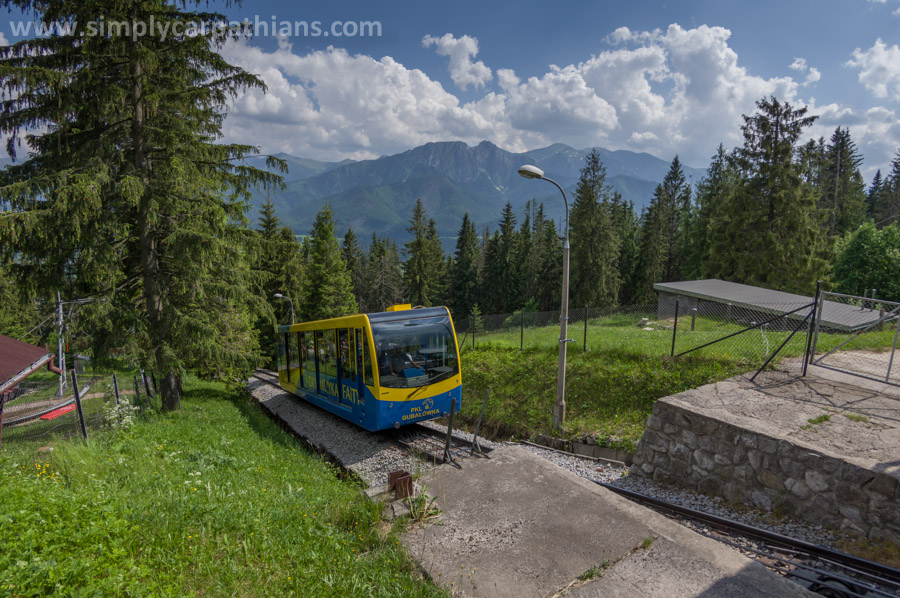
Zakopane sightseeing: Gubalowka – the best view of Tatras

Gubalowka - one of the most interesting view points of the Tatras, easily accessible and therefore, unfortunately, often very crowded. Many tourists ascend the peak using the funicular and go for souvenir shopping or to find restaurant to satisfy hunger. However, I would to write about different Gubalowka - interesting objects in the vicinity of the summit and what you can see from the top because the panorama is one of the best views of the Tatras.


The Gubalowka mountain ridge is full of housing buildings - this is the highest settlement (1122 m a. s. l.) in Poland and it belongs administratively to Zakopane. The largest oject visible from afar is the Radio and TV Tower, nowadays also providing mobile phone coverage and satellite television. The funicular is the most often visited attraction. It was built in 1938 and modernized fifteen years ago. The summit can also be reached by numerous hiking trails leading to Gubalowka from different directions.

You have to go down a few dozen meters from the upper funicular station to see the full panorama of the Tatras. The view covers most of the Tatra Mountains - from the Belianske Tatras to the distant peaks of the Western Tatras. The most conspicuous is Giewont Mountain with its silhouette of sleeping knight. You can also recognize almost every building in Zakopane, the complex of ski jumps and many other objects. Unfortunately it is impossible to see Rysy (the highest mountain of Poland) and Gerlach (the highest peak in the Tatras) from Gubalowka.

One of the worth seeing objects is the monument called Polonia Restituta located near the upper station of the funicular. Two-meter bronze figure shows the resurgent Poland. On the left hand of the woman there is sitting an eagle with spread wings ready to fly. The sculpture was made by Stanislaw Kaniak for world exhibition Art and technology in contemporary life in Paris in 1937.

Another interesting object is a metal cross standing near the Radio and TV Tower. It was commissioned in 1873 by Titus Chałubiński in Kuznice (local ironworks). The cross was founder's public confession of faith and it also commemorates his reconciliation with the family.

Gubalowka is worth visiting at any time of the year because of the spectacular views. I recommend to explore the area in the morning hours to do it in peace and quiet.

Saturday, May 30, 2015

Macrophotography: round-leaved sundew

Photographing the round-leaved sundew is not a quite easy thing. But don't be afraid, you do not have to be a professional with years of experience and very expensive equipment for macrophotography. The difficulties lie in the fact the majority of people simply do not notice it ;)


So firstly, you need to locate the sundew – its tiny leaves are almost whole green and it is hard to spot them among the bogs. I have spent more than an hour during a photographic tour on the wetlands before I found the first specimen and took a photograph of it. I must add that it wasn't my first search.

As for the shooting, should you choose the morning time when the light is not too sharp and there are still morning dew drops on the hairy leaves. Under a cloudy sky, you can make use of an artificial light source - a flash or headlamp. A plain white sheet of paper reflecting daylight may also be useful. Of course, interesting pictures can also be taken in the rain - the best is drizzle with tiny water droplets which gather on the leaves. Almost each leaf contains undigested remains of insects - sundew is real carnivorous plant!

You can tak macro photos by almost any type of camera - from small compact devices with often very good macro mode to SLR cameras with special lenses for macrophotography. Most of the following images were taken with SLR Pentax K-3 with the Soviet lens Helios 58mm type M42 attached to the camera with the appropriate adapters and rings for macrophotography.

Where to find the sundew? It can be often found in bogsmarshes and fens. The pictures where taken on the peat bog near Nowy Targ (Lesser Poland). Sundews grow there next to the observation platform, half a meter from the railings.


If you want to learn more about macrophotography and see those amazing plants – you are warmly welcome to our photo-tours and workshops.


Friday, May 22, 2015

Nature reserve - Bór na Czerwonem


Recently we have been discovering the charms of picturesque place which is the Nature Reserve Bór na Czerwonem. It is located in Podhale, Lesser Poland. The place has the true recreational potential - Nordic walking and cross country trails are led here, it can also be the target of a bicycle tour or a stroll. Some come here at odd hours and roam around with a camera ;) However, the nature reserve is primarily the place where extremely interesting species of plants are protected.

The area has been protected since 1925 but it was given the status of a nature reserve in 1956. Bór na Czerwonem is peatbog reserve, in which the raised bogs ecosystem (supplied with rainwater) and surrounding it humid forest communities are protected. This is an example of peatlands typical for Orava-Nowy Targ region. 


The name (czerwone = red) the reserve owes to algae, which in autumn assume a red color. But we can see here many more interesting species typical for the wetlands such as sphagnum moss, Cranberry, cotton-grass, different types of pine or fascinating common sundew. If these names do not say anything to you - just come here and see for yourself what a beautiful landscape they form :)


Tuesday, June 3, 2014

The Black Stork

The black stork is a real treat for the birdwatching lovers. Why? This bird is one of the rarest representatives of the quite popular in Europe stork family. Unlike his brother – the white stork, it keeps off human settlements.

The black stork
Its name comes from the colour of plumage which is mainly black with a green and violet sheen, except for the white 'bottom'. Legs and bill has strong red colour.  

The stork inhabits wetlands – it builds nests on strong and big trees in the vicinity of lakes and swamps. The nest can weight even 1000 kilograms! 

The picture above was taken in the Podhale region, next to our house;) Around the Tatras, on both the Polish and Slovak side you can watch these beautiful and rare birds. There are some places where you can meet them regulary.


Monday, March 31, 2014

Museum of photography and cinematography in Slovakia

We had a great chance to visit the Jozef Maximilian Petzval Museum in Spisska Bela. Andrzej is a photographer so we were laughing that it was a must-see for him ;) I also enjoyed it realy much.


Petzval inventions
Jozef Petzval was a mathematician, physicist and inventor who became famous for his work in optics. His achievements are used today in cinematography and astronomy. Among his inventions are the portrait lens and wide-angle lens. He also invented the opera glasses. You can see everything in the museum.

Museum is located in the center of Spisska Bela in the house of Jozef Petzval – the place where he was born and lived several years. The number of exhibits gathered there made an impression on us. You will find there not only the memorabilia of the inventor - the exhibition includes more than 600 exhibits documenting the history of photographic equipment. Beside the vast range of cameras and lenses visitors have also a chance to see how camera obscura and darkroom works or what stereoscopy (3D imaging) is. A part of exhibition is devoted to the beginnings of cinematography.


Visiting the museum with a digital guide. 

We highly recommend!

Contact:Petzvalova 30, 059 01 Spišská Belá
Phone: + 421 (0)52/459 13 07, +421(0)918 965 699,
E-mail: muzeum.petzval@stm-ke.sk, stmke@stm-ke.sk
Opening hours:
Monday - Saturday - 10:00 to 16:30 hrs.
Sunday - closed
Admission:
adults € 1.50
discounted € 1.00

making photos € 1.00
Providing discounts on the basis of the discount coupons EBC - European Club Benefit


Sunday, May 12, 2013

Nature photography for everyone


Crocus
How to photograph a chamois? What time of the day is the best to take photos of landscapes? Why you should use a special lens to do macro photography? These and several other issues are worth thinking about before going on a mountain outdoor photography session.

ANIMALS. Wild animals in their natural environment are usually very skittish. In the Carpathians species such as chamois, marmot, bear, deer and fox usually avoid close encounters with people. Watching and photographing
them is exacting, but the effort may bring a reward of great photos. The first issue is the choice of the time of the day convenient for animals observation. As a rule, these are the hours of the morning and afternoon, then meeting chamois and marmot is the most likely. The second issue is the selection of the appropriate camera equipment - long telephoto lenses are usually quite heavy, but allow you to shoot without approaching mountain fauna and disturbing it. The third important thing is patience. Sometimes wild animals come up close to a man only when get used to seeing and smelling the man - then you can do a lot of interesting shots.

Fox

Chamois


Sunrise in the Tatra Mountains.
LANDSCAPES. Beautiful colors, interesting chiaroscuro, phenomenal clouds ... each of us has seen breathtaking scenery in photographs available on the internet or on postcards. When they are created? Most people at that time sleeps well or is getting ready to rest. It is no secret that the most interesting landscape shots are made in the early hours in the morning and in late afternoon, during the sunrise and sunset. Outdoor photography session at dawn or dusk requires a lot of effort, but it can bring photographer great satisfaction. In addition to the strong will also a photographic equipment is needed, so that we can easily capture unforgettable landscapes. Firstly tripod - dawn and dusk are the moments when it is relatively dark. It is difficult to take a picture with e.g. half-second exposure - camera tripod will help you do this. Another important thing are the photo filters, especially graduated neutral density filters. They allow you to achieve better illumination of the dark areas of the foreground, which at dusk and dawn often remain in the deep shadow. It is important to provide power for our camera - it may sounds colloquially, but on a frosty morning or even chilly evening camera batteries will be depleted much faster. It would be a shame to lose an amazing shot by our own negligence ...

Sunset in the Tatra Mountains.
MACROPHOTOGRAPHY. Macrophotography is commonly known as taking pictures of objects in a large scale. Pictures of flowers, insects, fungi, water drops, etc. are in this group. To make a really big close-up you should purchase a specialized lens for macro photography. Almost every company offers this type of photographic lenses allowing to fill the whole frame with a small butterfly or ladybug. These lenses for most amateurs have one disadvantage - a high price. An alternative to an expensive brand macro lenses are the old manual lenses fitted to cameras with adapter rings. They allow seeing by the camera as by magnifying glass and can perform almost incredible close-up. With the manual lenses experienced photographers can do as good or even better shots than using expensive brand lenses, it’s just a matter of practice. The owners of compact cameras can also successfully try macro - most cameras is equipped with a special mode called "macro". If the close-up is not satisfying we are using special rings with old manual lenses and shoot pin’s head or tiny spiders. If you use your fantasy interesting shots can be taken with any camera and with many different lenses. 

Macrophotography.

That's the theory - now I invite you to use these tips with camera in your hand!