Showing posts with label mountains. Show all posts

Wednesday, December 9, 2015

Mountain chalets in Slovakia

Simple mountain chalets are popular type of accomodation in Slovakian mountains – Low Tatras, Greater Fatra, Little Fatra, Polana or even the Tatras.

Mountain chalet in the Greater Fatra
In the Choc Mountains
Some of the shelters are newly built in order to host hikers. These are small solid wooden buildings with well arranged interior - sleeping place, heater and cooking stuff (pots, cups, etc.). Latrine is a real luxury there :) However, there are also many chalets which are former shepherds' huts modified for tourism purposes. Some were solidly renovated, the others are in poor condition.

Most of the chalets are free of charge. After spending a night in such a place we are obliged to leave it in the previous condition. What does it mean in practice? Clean up after yourself, take your garbage, keep the latrine clean (if one exists) or chopp the wooace for the fireple. In fact, it is very important to comply with these rules in every place ;)

In the Greater Fatra
Most chalets have access to the fresh water but you should not expected the tap and sink inside ;) It means that there is a spring near the cottage. Sometimes the sign shows the way to the spring, however in most cases we have to rely on a good map with marked waters. Some shelters are located in a considerable distance from the water (even several kilometers) or the closest springs are seasonal – be prepared for that.

Planning accommodation in a particular shelter check if the place is open to public. A part of the huts is under the supervision of some tourism organizations which hold the keys to the buildings. You need to get the key before you set off on the trail.

Hiking with an overnight in mountain huts is a great adventure. Sleeping in simple conditions (sometimes being squeezed like sardines in a can), chopping wood, drying wet clothes on the strings stretched inside, shared cooking and finally a conversation with casual roommates have unforgetable charm :)

Enjoy!


Tatra Mountains
Low Tatras
Low Tatras
Choc Mountains
Low Tatras
Greater Fatra

Low Tatras
Greater Fatra
Polana Mountains

Wednesday, June 17, 2015

Zakopane sightseeing: Gubalowka – the best view of Tatras

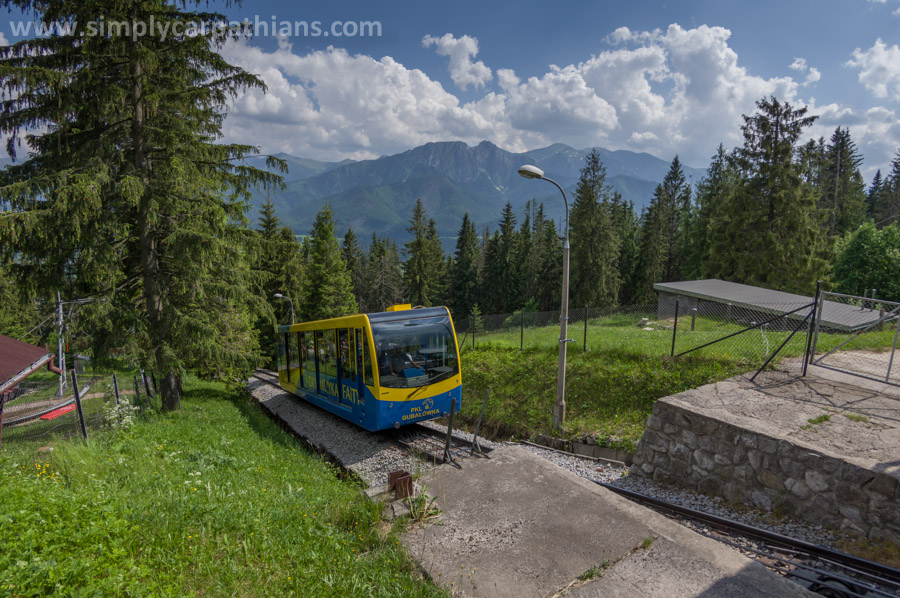
Gubalowka - one of the most interesting view points of the Tatras, easily accessible and therefore, unfortunately, often very crowded. Many tourists ascend the peak using the funicular and go for souvenir shopping or to find restaurant to satisfy hunger. However, I would to write about different Gubalowka - interesting objects in the vicinity of the summit and what you can see from the top because the panorama is one of the best views of the Tatras.


The Gubalowka mountain ridge is full of housing buildings - this is the highest settlement (1122 m a. s. l.) in Poland and it belongs administratively to Zakopane. The largest oject visible from afar is the Radio and TV Tower, nowadays also providing mobile phone coverage and satellite television. The funicular is the most often visited attraction. It was built in 1938 and modernized fifteen years ago. The summit can also be reached by numerous hiking trails leading to Gubalowka from different directions.

You have to go down a few dozen meters from the upper funicular station to see the full panorama of the Tatras. The view covers most of the Tatra Mountains - from the Belianske Tatras to the distant peaks of the Western Tatras. The most conspicuous is Giewont Mountain with its silhouette of sleeping knight. You can also recognize almost every building in Zakopane, the complex of ski jumps and many other objects. Unfortunately it is impossible to see Rysy (the highest mountain of Poland) and Gerlach (the highest peak in the Tatras) from Gubalowka.

One of the worth seeing objects is the monument called Polonia Restituta located near the upper station of the funicular. Two-meter bronze figure shows the resurgent Poland. On the left hand of the woman there is sitting an eagle with spread wings ready to fly. The sculpture was made by Stanislaw Kaniak for world exhibition Art and technology in contemporary life in Paris in 1937.

Another interesting object is a metal cross standing near the Radio and TV Tower. It was commissioned in 1873 by Titus Chałubiński in Kuznice (local ironworks). The cross was founder's public confession of faith and it also commemorates his reconciliation with the family.

Gubalowka is worth visiting at any time of the year because of the spectacular views. I recommend to explore the area in the morning hours to do it in peace and quiet.

Thursday, February 5, 2015

Tatry Ice Master - ice sculpturing championships


Every winter since 2013 a very interesting and spectacular competition takes place in the Tatras - the ice sculpturing championships called the TATRY ICE MASTER. Top artists from several countries of the world come to Slovakia to take part in the contest. During three days they have to complete the tasks - create ice sculptures in 3 different categories:

1. Bears
2. The country I come from
3. Abstract - free choice


That is amazing! You can watch the artist working, using different technics and tools, transforming ice blocks into fantastic shapes

The championship is accompanied by singers performances, daily contests, ice-shops and other amusements.

Everything takes place in the beautiful area of the High Tatras. There are splendid waterfalls 20 minutes walk from Hrebienok.

Directions: Hrebienok, The High Tatras, Slovakia. Take a funicular (or go on foot :) from Stary Smokovec to Hrebienok. On the way back you can enjoy 3 km long sledge track :)


Tuesday, October 28, 2014

Polana Mountains - the geological curio

Did you know that the biggest extinct volcano is located in Slovakia? For me it was a great surprise, that there is something so unusual and interesting close to my home. Nowadays the name of this volcano is Polana.

Slopes of the Polana Mountains, Slovakia
The Polana are medium-high mountains with forests, clearings, fields and lovely hamlets. The highest peak is Polana at 1458 m ASL. We named this place Slovak Tuscany ;) You can hike here (lot's of marked trails!), do some cycling trips or simply stay in one place and enjoy tranquility. Maps of the region you can buy in bigger towns or cities like Banska Bystrica.

The Polana Mountains are a geological curiosity. They used to be over 2500 m ASL high stratovolcano which finaly exploded and destroyed thyself. Nowadays we can find there interesting rocks (andesite or tuff - consolidated volcanic ash) and extraordinary rock formations. The mountain range is protected by Polana Protected Landscape Area. 

Waterfall Bystre
At the foothills of the Polana lies a town of Detva known for its folklore. Detva is a manufacturing center of famous Slovak music instrument fujara - shepherd's overtone fipple flute. It has really unique shape. You can see it in Detva museum or during one of the folk festivals which are held here. Some of them are even the international events. 

Detva is also known for its carved and painted wooden crosses which are the decoration of tombstones at local cemetery. They also stand as a roadside chapels. 

Man playing the fujara at folk festival in Detva.
There is (at least!) one more interesting place situated in the vincinity of the Polana. It is the wooden Protestant church from 1726 located in village Hronsek. Its wooden construction with severe interior can hold up 1100 worshippers. The site was enetered onto the UNESCO World Cultural and Natural Heritage List.

I highly recommend this lovely and little known region!

Farm stay, Slovakia, The Polana Mountains

Tuesday, July 15, 2014

Mountain insurance in Poland and Slovakia


The mountain rescue in Poland and Slovakia is provided by the Mountain Rescue Service organizations:

1. In Poland there are the Mountain Volunteer Search and Rescue (Górskie Ochotnicze Pogotowie Ratunkowe - GOPR) and the Tatra Mountains Volunteer Search and Rescue (Tatrzańskie Ochotnicze Pogotowie Ratunkowe – TOPR).

EMERGENCY NUMBER: +48 601 100 300


2. In Slovakia it is The Mountain Rescue Service (Horská záchranná služba – HZS).

EMERGENCY NUMBER: 18 300


INSURANCE

Poland: You don't have to buy any special insurance at the moment.

Slovakia: You are obliged to buy special mountain insurance policy. Otherwise you will have to cover the costs of your rescue while accident.

Where to buy the policy?

1. Alpenverein, Euro26 Sport are honoured.
2. Some commercial insurances offer the insurance. You may buy it in the office, online or via sms.
3. At the branches of the Mountain Rescue Service. The main office is located in the center of Stary Smokovec (opening hours from 7 AM).
4. Some hotels and Tourist Information Centers provide assistance in buying the policy.
5. At the ticket offices for example to the Slovak Paradise. It is not included in the ticket price, you buy it additionally.

Friday, July 4, 2014

The Tatra Mountain Guide

This time I will write something private. Probably I want to boast a bit ;) So... Finally, after an almost 3-year course, I passed exams and became the Tatra mountain guide. I am so happy, because now I can use all the hiking experience and geography knowledge I have, to show others the small part of the world which are the Tatras.

www.sliwinski-foto.eu 
Who is the Tatra mountain guide? It is a person who loves mountains, has vast experience and knowledge about the region and is entitled to lead private and organised tours. There are several levels of guidance – the first one allowes to lead tours along the marked trails, the others have permission for the climbing routes.

Course. During the course we learned not only the topography of the Tatras, but also about the nature, history and etnography of the region and surrounding area both in Poland and Slovakia. We had lots of lectures, coach trips, hiking tours, climbing and first aid trainings. But it was not enough – the most important thing was our own work.

I am very lucky because my husband is a guide too (the Tatra mountain guide and UIMLA guide) so we could talk about the mountains for hours ;) He also comes from the highlanders family so I had a chance to learn about the local culture and traditions from the inside.

Peolple. During the course I met wonderful people! We all are in different age, come from different parts of Poland, have different jobs and hobbys. But the thing that links us together is the passion for mountains. I am really greateful for the time we spent together.

Future. Maybe we will go for a trip together? ;)

Monika

P.S. Don't hesitate to ask any questions about the Tatra Mountains and surrounding area!


Thursday, May 8, 2014

Caves in Slovakia

There is over a dozen of caves in Slovakia open to visitors. They are placed in different mountain ranges all over Slovakia. Most of them are typical karst caves but there are few quite unusual like aragonite cave or ice caves. We had a great chance to visit some of them. You can read about our impressions below. We also put general information about the cave.

Stanišovská cave


It is a karst cave located north of the Janska Valley on the southern slopes of the Low Tatras, 15 km from Liptovský Mikuláš. What is really special about this cave is that there is no lights inside - you visit it only with headlamp (which guide gives to you at the entrance). Thanks to that you feel like a real explorer. If all visitors turn off the light for a moment you can experience the true darkness. Other attractions in the cave are tiny creatures that live in the water, small lake or dripstone (but not so spectacular like in other caves). 


PHOTOS:


READ ABOUT OTHER CAVES SOON!

Wednesday, April 9, 2014

The Choč Mountains

The Choč Mountains are a mountain range located in north-central Slovakia, west from the Tatra Mountains. The highest peak is Veľký Choč (1 611 metres above sea level). Small mountains but very diversified – you will find here forests, meadows, rocky summits, karst valleys, waterfalls and mineral springs. 

Prosiecka Valley
For those who would like to hike inside the ravines, climb ladders or walk through wooden footbridges we recommend Prosiecka Valley. It is a very picturesque trail, not very difficult and quite popular among tourists. The place impressed me much :)

The way back leads through Kvacanska Valley. It's main attraction is an old sawmill located in the bottom of the valley. Visitors can see how the machinery works. It is interesting both for children and adults.

Veľký Choč
Those who want to get more tired may ascend the highest peak - Veľký Choč. It's rocky summit is a great view point for surrounding mountain ranges - Tatra Mountains, Low Tatras, Fatra Mountains and others. Another option is climbing Prosečné - it is a shorter trip, almost all the time you walk in forest. 

Finally, after a very tiring trip ;) hikers can quench their thirst drinking healthy water from mineral springs in Lúčky or take a rest in a hot spring water park in Bešeňová. There is also a little lake with hot water in Kalameny - it is an non-commercial place.

Tiny beautiful mountains. Good things come in small packages ;)
 
Waterfall in Lúčky
Prosiecka Valley
Pulsatilla slavica
Old sawmill in Kvacanska Valley

Monday, March 24, 2014

Shepherding in the Tatra and other Polish mountains

Autumn morning, I'm sitting in the kitchen and sipping coffee. Suddenly I hear gentle buzzing, with time the sound becomes clearer. I look out the window and see a flock of sheep moving along the road towards the nearby meadows. Small bells tinkle hung on the neck of some sheeps. Ah, the owner is leading his herd to the pasture. Grazing season, which traditionally runs from April 23 (St. Wojciech day) to September 29 (St. Michael the Archangel day) is already completed - the sheep descended from the Tatra mountain pastures. Now they are driven only on the foothill meadows.
 
Pastoral customs, traditions, techniques and equipment came to the Polish mountains from the south. They were strongly influenced by Vlachs - nomadic people coming from the Balkan area, who in the early Middle Ages began centuries long pilgrimage to the north. Nomads assimilated with the inhabitants of the Carpathian range and taught them new skills. Pastoral way of life came upon a breeding ground - difficult natural conditions (harsh climate and poor soil) favoured more animal husbandry than cereal farming. Shepherding started to develop in the Tatra and other Polish mountains
 
What did the traditional pastoral season look like? Each owner wanted to send his sheep to the mountain pasture for summer. It would entail leaving the household for several months, what was impossible. Therefore the function of baca (the main shepherd) was established a man to whom farmers entrusted their flocks for summer time grazing. Baca was choosing some helpers – younger shepherds and set off to the mountain pastures owned by the village. Walking to the pastures called redyk could last even several days, depending on how far from the mountains the village was located. On a pasturage shepherds lived in a wooden hut called bacówka. Apart from grazing they were protecting sheep from predators or getting lost and manufacturing products ​​from sheep's milk. The best known are three types of cheese - oscypek, bundz and bryndza. Grazing was terminated with autumn redyk - sheep descent from the mountains. It was a very solemn event, accompanied by singing and music. Then the main shepherd settled up with sheep owners and returned them their flocks. Children welcoming redyk were receiving little pieces of cheese in the shapes of animals. Many traditions and superstitions associated with the pastoral season come from a borderline between religion and pagan beliefs. They are subject of a number of ethnographic research nowadays.

What about shepherding in the Polish mountains today? History of individual pastoral areas and its influence on contemporary sheep grazing caused diversification of shepherding in different regions of Poland. Idyllic view with sheep in the mountain pastures is not as common as it was in the past. Nevertheless we can still meet shepherds or even visit their huts while hiking on the mountain trails in Gorce, Beskids or Pieniny. In some areas (eg in the Bieszczady Mountains) the aim is to renew the tradition of pastoralism.

In the Tatra Mountains, where shepherding had been completely liquidated due to the nature conservation in the 70's, it was decided to restore grazing. Decisive influence had cultural issues - perennial relationship between the highlanders and the Tatras and richness of traditions and customs as its effect. In 1981, shepherding returned in a form of so-called Cultural grazing of sheep and cattle in the Tatra Mountains. What does it mean? Under agreements with the Tatra National Park highlanders can graze sheep on some of the clearings. They must, however, obey several rules including speaking in a dialect, wearing the original highlander outfit, whether be assisted by traditional herding dogs – the Polish Tatra sheepdogs. The are many more requirements, but thanks to them we can learn more about old customs and try products prepared according to original recipes.

Extremely interesting event is the Carpathian Sheep Transhumance organized for the first time in 2013. It is an international project aimed at meeting people involved in shepherding across the whole Carpathian range linked together with an exchange of experiences. This is the traditional wander of shepherds and flocks through the mountain area of the Carpathian countries - Romania, Ukraine, Poland, Slovakia and Czech Republic. The trail is about 1,200 kilometers long (10-15 kilometers a day) and takes place between May and September. The wander is accompanied by various events.

Dusk, the day is slowly coming to the end. I hear the tinkling sound again ... The sheep are coming back to the pen for the night

TEXT WAS PUBLISHED ON LINK TO POLAND WEBSITE.